Prof Valmed Wins DMEA Award, Certify It And They Will Come
“Build it and they will come” is a classic tech advice by Paul Graham, founder of Y-Combinator - Silicon Valley’s most prominent startup accelerator. It defined the last two decades of software development as people could increasingly freely source the solutions they needed:
The exciting thing about the Internet is that it's shifting everything in that direction. The hard part, if you want to win by making the best stuff, is the beginning. Eventually everyone will learn by word of mouth that you're the best, but how do you survive to that point? And it is in this crucial stage that the Internet has the most effect. First, the Internet lets anyone find you at almost zero cost. Second, it dramatically speeds up the rate at which reputation spreads by word of mouth. Together these mean that in many fields the rule will be: Build it, and they will come. Make something great and put it online. That is a big change from the recipe for winning in the past century.
In such a busy and information-dense marketplace, the filter that mattered was quality and quality was the thing that unlocked virality - people recommended great products to their colleagues, who then did the same, creating a viscous cycle - and led to free distribution. Quality can take many forms, of course - speed, ease of use, practicality, security, customer support, etc - but it rarely had to do with regulatory compliance.
This is where the medical sector is quite different. In Germany after building the product software companies have to go through various regulatory checks - from quality assurance, to risk management, to security, software life-cycle management, usability engineering and clinical evaluation - all before they can sell anything. This process can take anywhere from 6 months to over 2 years, depending on the risk class assessment, and it repeats with any major feature release.
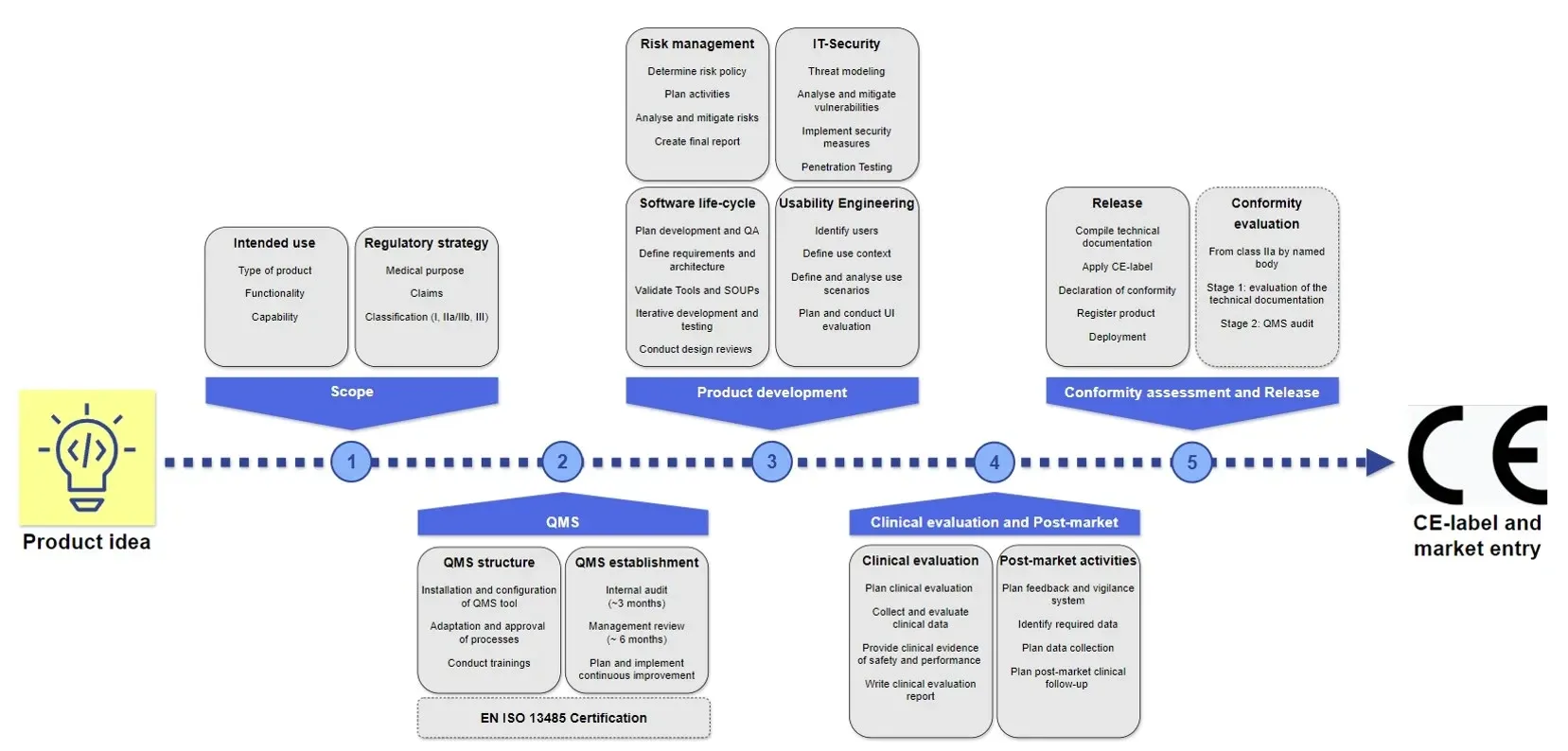
What this means is in many ways that the bottleneck is no longer just building a great product, but also getting it certified. This of course implies that whoever certifies and launches first, has a great advantage over everyone else and is presumably the desired option.
This is surely what the DMEA nova Award suggests, from eHealth (translated):
In 2026, a special focus was again placed on promoting innovation and young talent. Around 70 startups presented their solutions and ideas for the healthcare of tomorrow in the Startup & Innovation Area. One particularly outstanding solution was awarded the DMEA nova Award this afternoon. The startup Prof. Valmed from Langen in Hesse prevailed against strong competition in the pitch rounds and convinced the expert jury. Their AI tool supports physicians in their daily work with diagnoses and treatments, making their work more efficient and providing training to ensure the safe and effective use of AI.
Prof. Valmed is a CE Class IIb certified LLM co-pilot for diagnostic and therapeutic decision support that according to their website achieves 76.2% accuracy, while another study suggests that it’s on par with ChatGPT-5. It has been on the market since late 2025 and has been deployed to… one major hospital. In the mean time, leading but non-certified LLMs are being used by nearly 90% of clinicians, no questions asked.
So what gives? We can cross out the regulatory point and at 900 EUR per seat per year, price is also not a problem for the Professor. What remains are all product questions that go back to that original Paul Graham essay: in order to win, you need to make the best product. And this remains true even in a world where you need to gain approval to launch, as the market’s revealed preference clearly demonstrates. "Certify it and they will come" is not how it works.