Agentic AI in ORBIS, Corti Agentic Framework, Dedalus Existential Risks
Last week Dedalus announced that it is stepping up on the agentic HIS arena, from E-HEALTH.COM (translated):
Dedalus HealthCare has made this approach an integral part of ORBIS. As a result, ORBIS is evolving from a documentation system into an intelligent clinical partner – with AI that is not an isolated add-on tool, but deeply embedded in ORBIS workflows, across the entire treatment process and across all professional groups.
At the heart of this development is the partnership with Corti, a leading platform for agent-based AI in healthcare. Corti's framework generates agents that can not only understand clinical and operational processes, but also plan and execute them – from gathering patient context and extracting structured clinical facts to preparing logical next steps. Dedalus combines this foundation with its deep integration into ORBIS and decades of clinical process expertise.
Beyond the agent platform, established clinical knowledge is also incorporated into the framework: Renowned knowledge sources such as Thieme and Elsevier ClinicalKey are integrated into the Corti platform. This allows clinicians to use sound medical content directly in their work context – without leaving ORBIS.
Corti’s agentic framework makes a lot of sense:
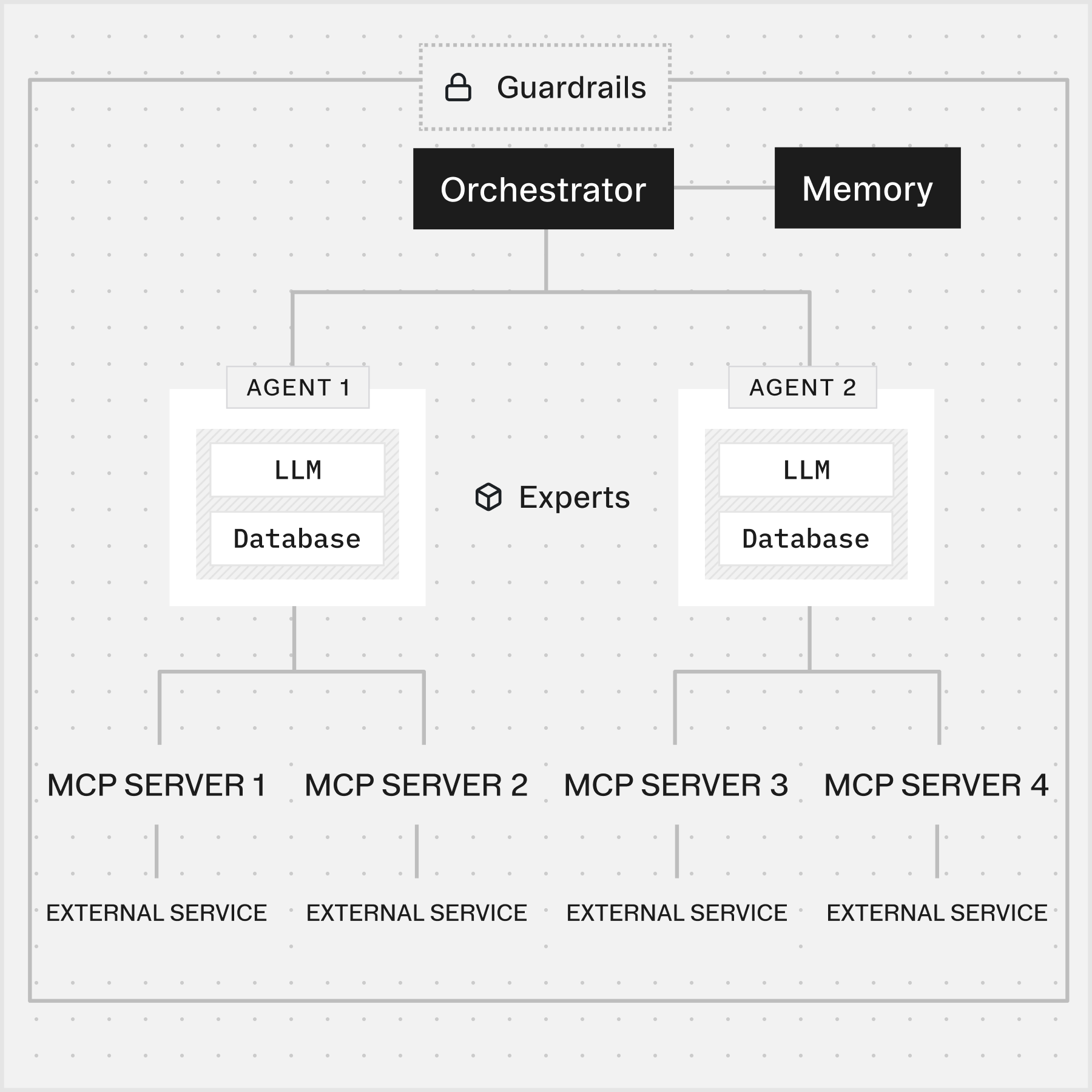
It also aligns quite well with the harness-as-a-platform idea I talked about last week:
To operate multiple models and provide them with the context, rules and permissions under which they should act, you need a system: you need harness. What is that? Put simply, if models are the brain of the agent, then the harness is all the other organ systems in the body - nervous, skeletal, muscular, etc. The brain comes up with an idea, but the body’s limits dictate what is actually possible to do.
So the harness layer becomes very central in the whole task execution, as it drives model and tool calls, manages conversation state and context, applies approval policies.
As such, it functions as a shared control layer for AI across teams within an organisation, which is another way of saying that it acts as a platform on which organisation-specific agents, apps and experiences are built.
Dedalus Partnership
Dedalus’ partnership with Corti was first announced in July 2025 and the focus was on scribing and documentation:
Copenhagen, Denmark, July 3, 2025 – Dedalus, one of the world's largest providers of software applications in the healthcare sector, and Danish HealthTech company Corti are entering into a strategic partnership to transform the future of clinical documentation. The collaboration integrates Corti's healthcare-specialized AI infrastructure into Dedalus' new ORBIS Speech Assistant, aiming to streamline medical documentation processes, reduce clinician workloads, and improve the quality and efficiency of care.
While not mentioned in the first announcement, this initial rollout was only for Germany. The partnership was then renewed and expanded to other countries in April this year. A key point was put on the conciseness of the models (emphasis mine):
The AI underneath is purpose-built for healthcare, not adapted from a general-purpose model. That distinction matters in practice. General-purpose AI models tend toward verbosity and struggle with the nuanced, fast-moving demands of a clinical environment. Corti's models are built specifically for medical speech, which means fewer inaccuracies, more reliable outputs, and documentation that supports clinical decision-making.
This argument sounds compelling and I, for one, am totally on board with the appeal of short and to-the-point communication. Clinicians have full plates and offloading those plates starts with focusing the otherwise dispersed and duplicate information. Corti gets that, which is why they are focused on serving only the relevant information via their Buddy agent. Again from the very first article (emphasis mine):
ORBIS Buddy offers the most visible entry point into agent-based work – a clinical assistant that is cross-platform, directly integrated into ORBIS, and can be used via natural language and voice. The goal is to noticeably relieve the burden on clinicians: ORBIS Buddy reduces administrative complexity, simplifies access to relevant information, and seamlessly integrates AI-powered support into the clinical workflow.
The unique feature of ORBIS Buddy lies in the interplay of specialized AI agents that work together in a coordinated manner within ORBIS. A single query can trigger several coordinated processing steps in the background – such as the analysis of clinical documentation, the inclusion of relevant findings and medication data, the use of integrated knowledge sources, and the structured presentation of results for the respective treatment context. This ensures that the answers are not only quickly available but also context-related, comprehensible, and directly integrated into the clinical workflow.
What’s funny about this is you’d think that a less-verbal model would mean Corti uses up fewer tokens and is thus cheaper, but that’s not the case. In order to simplify complexity, Buddy needs to first read all of the data there is, including from a growing number of external sources. This cost is reflected in Corti’s business model, which is usage-based.
This is not a critique of their approach; any other model would and should do exactly the same. But the outcome is that the more work Corti does and the more data it gets access to, the higher the cost for Dedalus. This is an expensive proposition, one that Charite managed to avoid with Cle, but perhaps it is all worth it if it helps Dedalus win more customers, or at least to retain them.
The problem with agentic interfaces is that they commoditise the layers underneath them: clinicians primarily interact with the AI agent, which then fetches the informations and does the actions, reducing all the other software to an API call. Dedalus, by means of being the underlying hospital information system - providing both software and data - runs exactly that existential risk.