
Health Tech Structural Shifts, Winners and Losers

I didn’t focus on the inpatient vs outpatient setting when I discussed the Corti API yesterday, even though I included it in the visual. But I want to do it today.
For an outsider it’s not obvious that hospitals in Germany don’t just follow different reimbursement rules, but also utilise different software systems (hospital information system, or HIS; in German KIS) to what outpatient facilities such as primary care offices, specialised clinics and ambulatory centres have (practice management software, or PMS; in German PVS).
The healthcare market in Germany is complex and I’ve written about the paradigm shift that it is currently going through:
Healthcare regulation in Germany is especially complex, as there are both public and private insurance paths, both of which are decentralised (there are a total of 130 health funds which compete with each other), and then there are the 16 states, each with their own rules and price tiers. The in-patient and out-patient care have different reimbursement rules and codes, and a hybrid approach is going to be introduced soon as well. The software used is often 20+ years old and so are the computers. Different data is sent to the ePA (EHR) for in-patient and for out-patient care and new decisions require the approval of multiple committees. At the same time, there are multiple reforms in discussion/adoption (KHZG, KHVVG, GKV-Beitragssatzstabilisierungsgesetz, GeDIG) and no body really knows what tomorrow will look like.
This immense complexity and slow speed is what kept for a long time many innovations away. On one hand few startups had the funding to navigate that map, wait to close the deal or implement a highly custom integration. And on the other, the established HIS incumbents had no incentive to enable those integrations.
But now a paradigm shift is about to kick in, enabled by three separate forces.
First, hospital staff and budgets were always under pressure, but reform cuts are threatening the viability of the system. Second, SAP IS-H is retiring next year, bringing down Oracle’s i.s.h.med with it, leaving an estimated 20% of the German HIS market without a replacement. And third is the arrival of LLMs with their high usefulness and low technical requirements, which led to their almost immediate adoption even when it was not allowed, based on the regulatory requirements.
Those three factors - two of which put pressure on the system, while the third one releases it - are the reason I think the market is changing in a meaningful way. Hospitals knew about the SAP retirement since 2022 but so far few have a change plan (2-3 years) or funding (200m EUR) in place. So that 20% of the market is now under acute pressure from two sides: budget cuts and no running system to easily/cheaply switch to, with time running out. The only viable release button: relatively cheap LLMs.
It is that paradigm shift that is opening the doors to both new growth avenues and new entrants. I’ve covered some of those companies individually in the last months, see Epic, Avelios, Dedalus, Heidi, Tandem Health, Doctolib, Microsoft and Delos Cloud. But it is considering their place in the value chain, juxtaposed with one another, that highlights their different strategies.
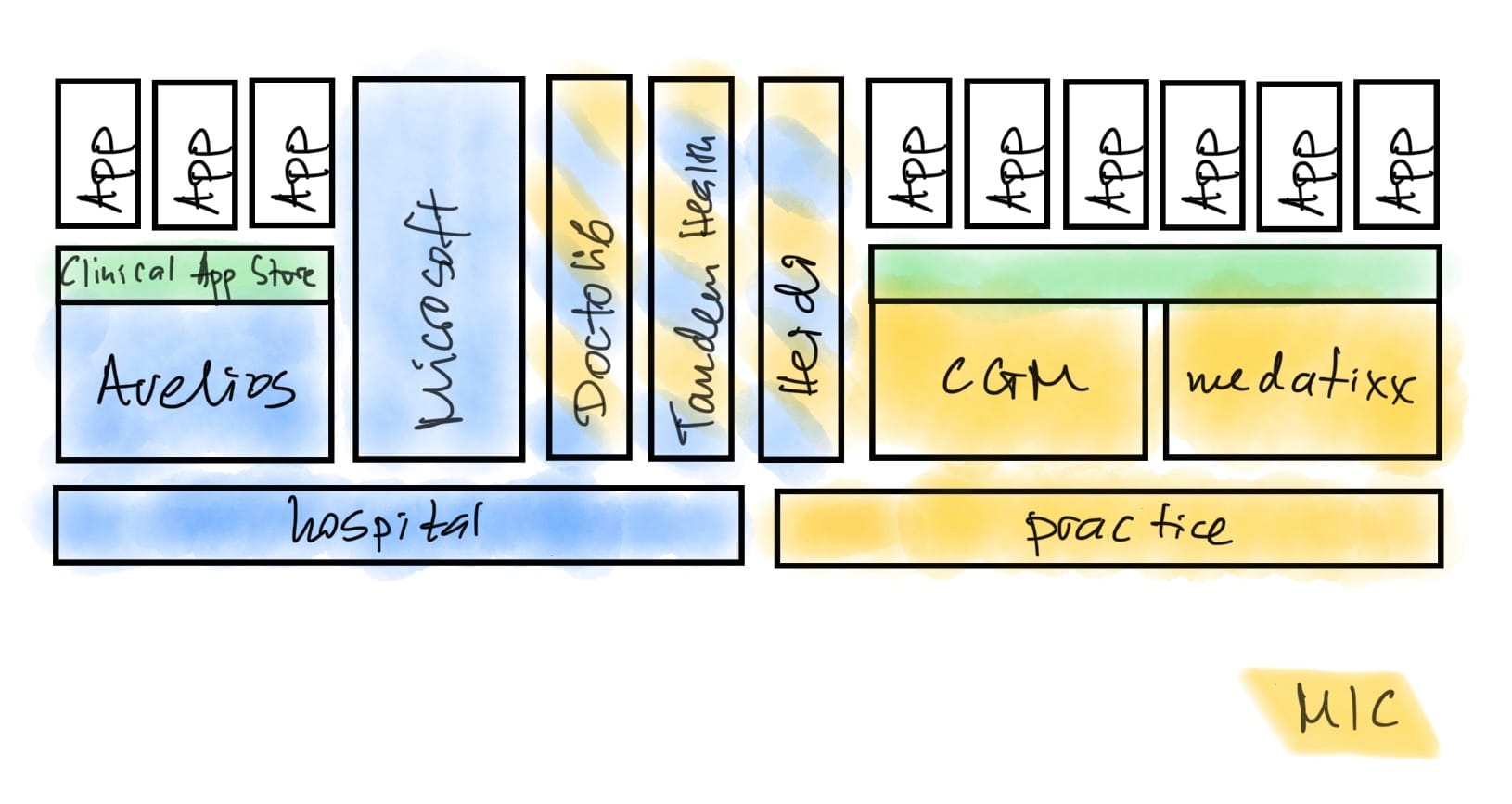
Avelios, in its effort to displace the traditional closed-off HIS incumbents, is attempting to not just ease the integration of third party apps, but to, in many ways, aggregate them. Similar opportunity is open on the outpatient side. I am yet to look into that space.
Microsoft, which already owns a big part of the enterprise process alongside SAP, is very well suited to capture that App Store opportunity. But is instead verticalising and focusing on the clinical workflow, headed towards the HIS level.
Doctolib, Tandem Health and Heidi all started off as one-trick ponies that worked across hospital and practice settings in the app layer, and are now also verticalising in their attempt to become the new universal clinical OS.
And then there is Corti, which is positioned to win no matter how the playing field changes.